PREFACE · GUITAR BASICS
Guitar Reference Points: Learn the Parts and the Language
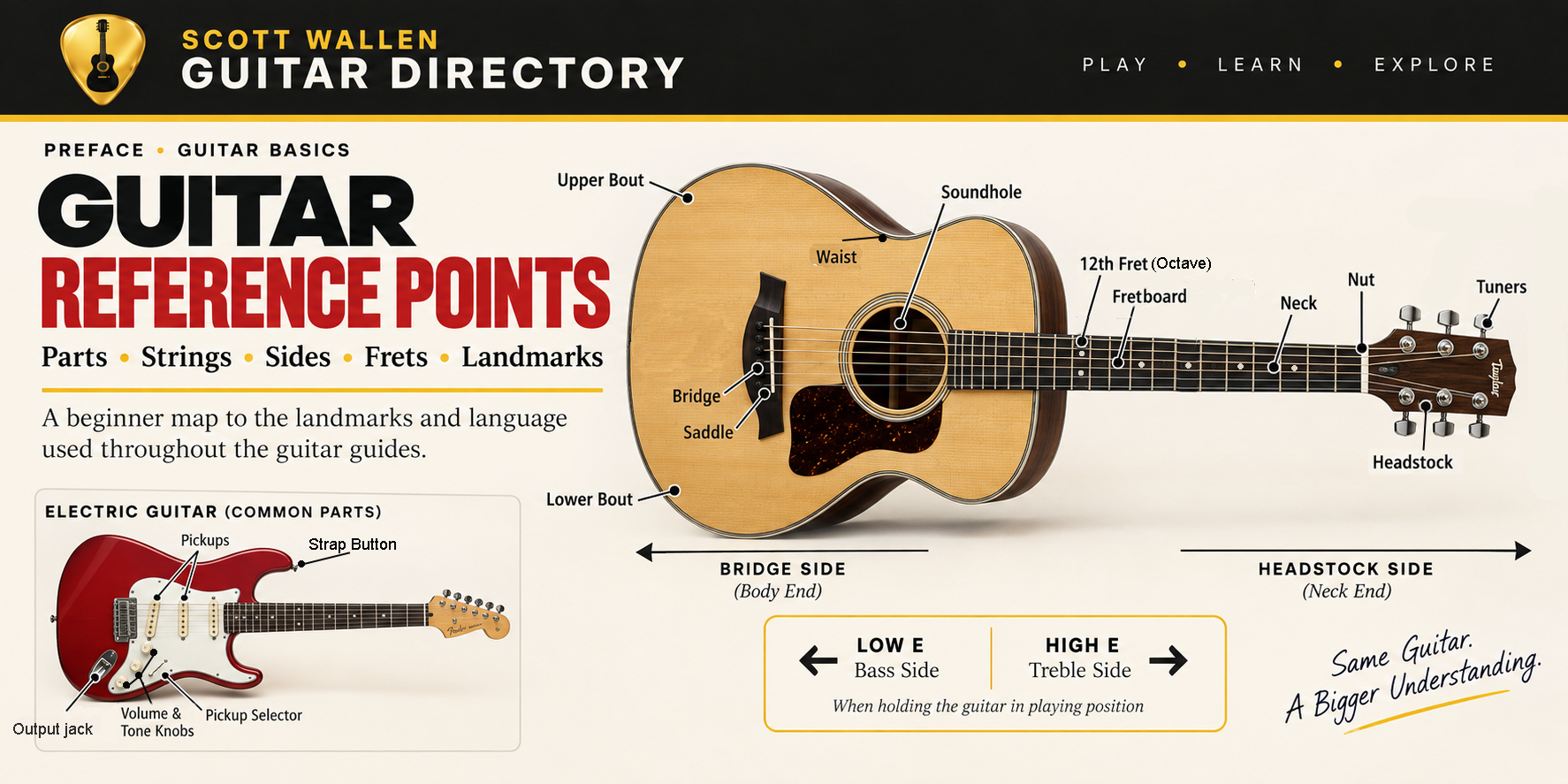
Guitar instructions become much easier to follow once the instrument has landmarks. This guide gives names to the strings, major parts and directions used throughout GuitarSearch.org.
WHY THIS PAGE EXISTS
A reference point only helps if the reader knows where it is
A setup guide may say “measure the bass E at the 12th fret” or “check the saddle on the treble side.” Those instructions are concise only after the vocabulary is familiar.
This page is the map. It is not intended to turn every guitar part into a repair lesson. It gives the reader enough orientation to understand descriptions, measurements, identification clues and later setup guides.
Reference language prevents ambiguity. “Left” and “right” can change depending on how a guitar is being held or photographed. “Bass side,” “treble side,” “headstock side” and “bridge side” remain much more useful.
THE SIX STRINGS
Low E to high E
In standard tuning, a six-string guitar is commonly described from the thickest, lowest-pitched string to the thinnest, highest-pitched string: E, A, D, G, B, E.
Low E and high E are different strings with the same letter name. “Low” and “high” describe pitch—not where the string appears on a photograph.
ORIENTATION WORDS
Directions that stay useful when the guitar moves
These terms work in photographs too. Even if the guitar is upside down or rotated, the bass side is still the low-E side and the bridge side is still the bridge side.
HEADSTOCK & NECK
The string begins its journey here
- Headstock. The end of the neck that commonly carries the tuning machines and brand logo.
- Tuning machines / tuners. The geared hardware used to change string tension and tune the instrument.
- String posts. The posts around which the strings are wound on many tuning-machine designs.
- String tree or retainer. Found on some guitars to change the string's downward angle between the nut and tuning machine.
- Nut. The slotted part at the headstock end of the fingerboard that guides string spacing and helps establish first-fret string height.
- Neck. The long structural portion carrying the fingerboard and frets.
- Fingerboard / fretboard. The playing surface on the front of the neck. Both terms are commonly used.
- Frets. The metal fret wires that divide the fingerboard into pitch positions.
- Position markers / fret markers. Dots or other inlays used as visual references along the fingerboard.
FRET NUMBERS & THE 12TH FRET
Count from the nut toward the body
Frets are numbered beginning with the first fret immediately after the nut. The numbers increase as the player moves toward the guitar body.
The 12th fret is especially useful because it marks the octave and sits at half the nominal scale length. That is why it appears repeatedly in action, scale-length and intonation discussions.
Example: If a guide says “measure the low E action at the 12th fret,” find the thickest string, locate fret number 12, then measure the vertical gap from the top of that fret to the underside of the string.
BODY SHAPE
Upper bout, waist and lower bout
The curved outline of a guitar body has its own reference vocabulary. These terms are especially useful when describing acoustics, hollow bodies and traditional electric shapes.
- Upper bout. The wider body area nearest the neck.
- Waist. The inward-curving narrow area between the upper and lower bouts.
- Lower bout. The wider body area farthest from the neck; on many guitars it is the largest part of the body outline.
- Cutaway. A body contour that removes part of the upper-bout area to provide easier access to higher frets.
- Neck joint. The area where the neck and body meet.
- Heel. The reinforced portion at the body end of many guitar necks.
“Shoulder” may make conversational sense, but “upper bout” is the more useful guitar-anatomy term.
ACOUSTIC REFERENCE POINTS
Parts commonly encountered on an acoustic guitar
- Top / soundboard. The front vibrating plate of the body.
- Back and sides. The remaining major body surfaces forming the acoustic chamber.
- Soundhole. The opening in the soundboard on many acoustic designs.
- Rosette. The decorative and sometimes structural ring around a traditional round soundhole.
- Bridge. The component attached to the soundboard that supports the saddle and anchors or redirects the strings depending on the design.
- Saddle. The bridge-side contact point for the strings.
- Bridge pins. Used on many steel-string acoustics to retain the ball ends of the strings at the bridge.
- Pickguard. A protective surface intended to reduce pick wear on the top.
ELECTRIC REFERENCE POINTS
Parts commonly encountered on an electric guitar
- Pickups. Transducers that sense string vibration and produce the electrical signal.
- Pickup selector. A switch used to choose or combine pickups.
- Volume and tone controls. Knobs controlling signal level and tonal filtering.
- Output jack. The connection point for the instrument cable.
- Bridge. The body-side string-support assembly. Designs vary widely.
- Saddles. Many electric bridges provide one saddle per string, allowing individual height and intonation adjustment.
- Tremolo / vibrato bridge. A movable bridge system that lets the player temporarily change string pitch.
- Pickguard. A protective plate that may also carry pickups, switches and controls.
WORDS THAT CHANGE WITH THE GUITAR
Not every instrument has every part
A classical guitar, steel-string acoustic, archtop, solid-body electric, headless guitar or extended-range instrument may use different hardware. The reference language should describe the guitar that is actually in front of you.
For example, some guitars do not have a traditional headstock. Some bridges do not use bridge pins. Some electric guitars have fixed bridges while others have movable vibrato systems. Seven- and eight-string instruments add strings beyond the six-string reference used on this beginner page.
Learn the standard map first. Then unusual guitars become easier to describe because you can explain what changed from the familiar reference.
RELATED GUITAR BASICS
Use the map, then enter the setup system
DIRECTORY POSITION
Know the landmarks before following the directions
Guitar vocabulary becomes useful when it reduces confusion. Knowing the difference between the low E and high E, the bass and treble sides, the upper and lower bouts, or the nut and saddle makes later instructions shorter and more precise.
The goal is orientation—not memorization. Use this page whenever another guide names a part or reference point that has not become familiar yet.
SUPPORTING PERSPECTIVES
See the reference points on real guitars
A labeled diagram gives you the map. Seeing the same parts on real instruments helps the vocabulary stick. These two short Fender overviews walk through the basic anatomy of acoustic and electric guitars using the same familiar landmarks: headstock, neck, strings, body and bridge.
Fender · Anatomy of the Acoustic Guitar A simple walk through the major acoustic-guitar reference points, from the tuning machines and nut through the neck and body to the bridge.
Fender · Anatomy of the Electric Guitar The same basic orientation on an electric guitar, with the addition of pickups, controls, individual bridge hardware and other electric-specific parts.
Look for what stays the same: Acoustic and electric guitars may use very different body hardware, but the basic map remains familiar—headstock, nut, neck, fretboard, frets, strings, body and bridge.
Fender is credited as the source of the supporting videos and reading material above. Their inclusion is for educational commentary and reference and does not imply sponsorship, affiliation or endorsement of GuitarSearch.org.