GUITAR GUIDE 005 · GUITAR BASICS
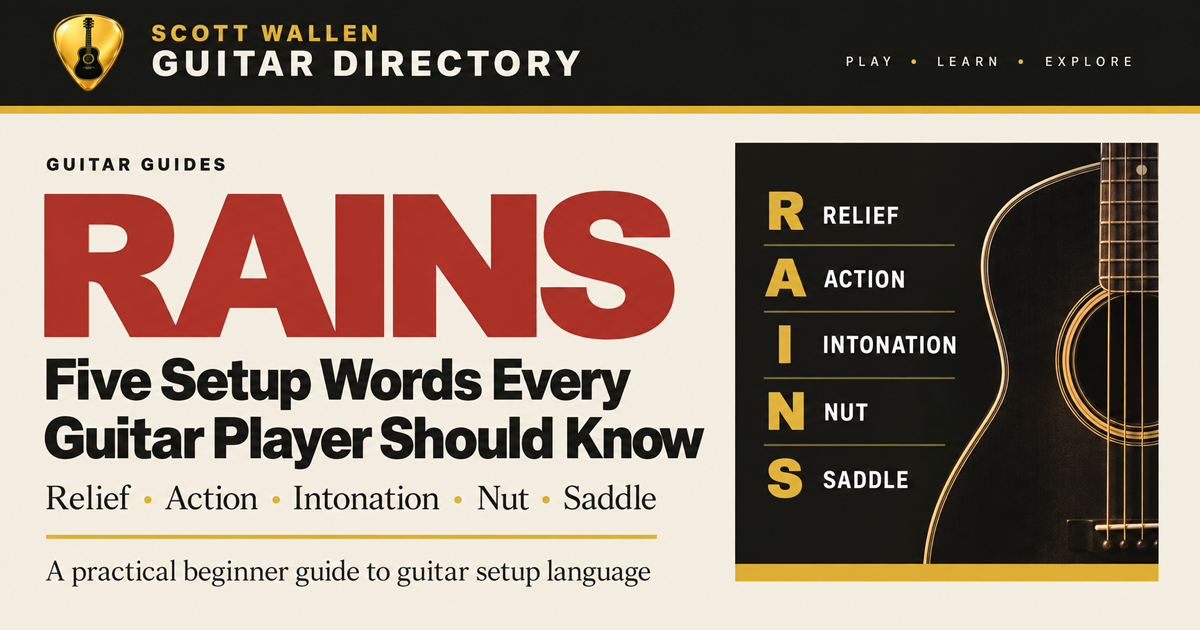
RAINS: Five setup words every guitar player should know
You do not have to perform your own guitar setup to understand what a technician, seller or experienced player is talking about. Five common terms explain much of what determines whether a guitar feels comfortable, plays cleanly and stays in tune across the neck.
WHY THIS MATTERS
Knowing the words makes the guitar easier to understand
A guitar can feel hard to play, buzz in one area, pull notes sharp or simply seem “off” without the player knowing why. Setup vocabulary gives those observations names. Once the terms make sense, conversations about playability become much easier to follow.
RAINS is a memory aid—not a setup sequence. The letters help you remember five terms. They do not tell you what to adjust first or suggest that every player should make those adjustments personally.
RAINS AT A GLANCE
Five words, five different jobs
R · RELIEF
The neck is usually not perfectly straight
Relief is the small amount of forward curve intentionally left in a guitar neck. A vibrating string moves in a wide arc, especially near the middle of its speaking length, so a little relief can give that motion room without forcing the entire action unnecessarily high.
- Too little relief can contribute to buzzing. A neck that is too straight—or bowed backward—may leave too little clearance for the vibrating strings.
- Too much relief can make the guitar feel harder to play. The strings can sit unnecessarily high through the middle of the neck.
- Relief is commonly influenced by the truss rod. That does not make the truss rod a general-purpose action control.
Player clue: If the action seems noticeably different through the middle of the neck, relief may be part of the conversation.
Understanding Guitar Neck Relief →A · ACTION
How high are the strings above the frets?
Action is the distance between the strings and the frets. It is one of the first setup qualities a player notices because it directly affects how much effort is required to fret notes and chords.
- Higher action can require more fretting pressure. That may be tiring for a beginner or uncomfortable for any player if the height is excessive.
- Lower action can feel fast and easy. But lowering the strings too far may create unwanted fret buzz, depending on the guitar, the frets and the player's attack.
- Action is the result of several things working together. Relief, nut-slot height, saddle or bridge height and fret condition can all affect what the player experiences.
Player clue: When someone says a guitar is “easy to play” or “fighting me,” action is often part of what they are feeling.
Understanding Guitar Action →I · INTONATION
Being in tune is not the same as staying in tune up the neck
Intonation describes how accurately the guitar plays pitch as notes are fretted farther up the neck. A guitar can have perfectly tuned open strings and still sound increasingly sharp or flat when chords and notes are played higher on the fretboard.
- Open-string tuning is only the starting point. Intonation asks whether the instrument remains accurate after the string is fretted.
- String condition matters. Old or damaged strings can make intonation difficult to judge.
- Electric and acoustic adjustment methods differ. Many electric bridges provide individual saddle adjustment; acoustic compensation is usually less individually adjustable.
Player clue: If the guitar is tuned correctly but chords sound increasingly sour higher up the neck, intonation deserves attention.
Understanding Guitar Intonation →N · NUT
A small part with a large effect near the first frets
The nut sits where the fretboard meets the headstock. Its slots guide the strings, establish their spacing and help determine how high the strings sit above the first few frets.
- Slots that are too high can make first-position chords harder. Fretting near the nut may require extra pressure and can pull notes sharp.
- Slots that are too low can create open-string buzzing. There may not be enough clearance over the first fret.
- The nut also affects tuning behavior. A string that binds in its slot may not move smoothly as it is tuned or bent.
Player clue: If open-position chords feel surprisingly difficult on an otherwise playable guitar, nut-slot height may be worth checking.
Nut & Saddle: The Two Ends of the String →S · SADDLE
The other end of the vibrating string
The saddle is the bridge-side contact point for the strings. On an acoustic guitar it usually sits in the bridge; on many electric guitars each string has its own adjustable saddle. Saddle height and position can affect action and intonation, and on an acoustic the saddle is also part of the path carrying string vibration into the bridge and top.
- Saddle height contributes to action. Raising or lowering the bridge-side contact point changes string height.
- Saddle position contributes to compensation. The speaking length of the string is adjusted slightly so fretted notes can play more accurately in tune.
- Acoustic saddles deserve care. Removing material is easy; putting it back is not.
Player clue: When an acoustic guitar's action is being discussed, the saddle is usually one of the parts a technician will evaluate.
Nut & Saddle: The Two Ends of the String →THE IMPORTANT DISTINCTION
Vocabulary first. Adjustment later.
Understanding setup terms does not require turning screws, filing slots or sanding saddles. In fact, knowing the vocabulary can help a player recognize when a guitar needs attention without guessing at the repair.
Describe the symptom before prescribing the adjustment. Buzzing, difficult action or tuning problems can have more than one cause.
DIRECTORY POSITION
Learn enough language to judge the guitar in front of you
GuitarSearch.org uses setup vocabulary as part of identification, inspection and buying guidance. The goal is not to turn every visitor into a repair technician. It is to make common guitar language understandable enough that a player can ask better questions and recognize what deserves a closer look.
RAINS gives five useful starting words: Relief, Action, Intonation, Nut and Saddle. Once those terms are familiar, descriptions such as “high action,” “too much relief,” “nut slots are high” or “intonation is off” stop sounding mysterious.
RAINS helps you name what you are seeing, hearing and feeling. The individual guitar still decides what actually needs attention.