GUITAR GUIDE 008 · GUITAR BASICS
Understanding Guitar Neck Relief
Relief is the controlled forward curvature of the neck beneath the strings. It is not the same thing as action, even though a change in relief can change how the action feels through the middle of the neck.
FROM RAINS
R is for Relief
In the RAINS memory aid, relief is the neck-curvature term. A guitar neck under string tension is usually set with a very small amount of forward curvature so the strings have room to vibrate without requiring unnecessarily high action.
The important sentence: Action is not relief. Relief can affect action. Relief should be established before final action is set.
WHY RELIEF EXISTS
A vibrating string needs room to move
A plucked string does not vibrate as a perfectly thin straight line. Its motion is wider through the middle of its vibrating length. A small amount of forward neck relief can provide useful clearance beneath that moving string.
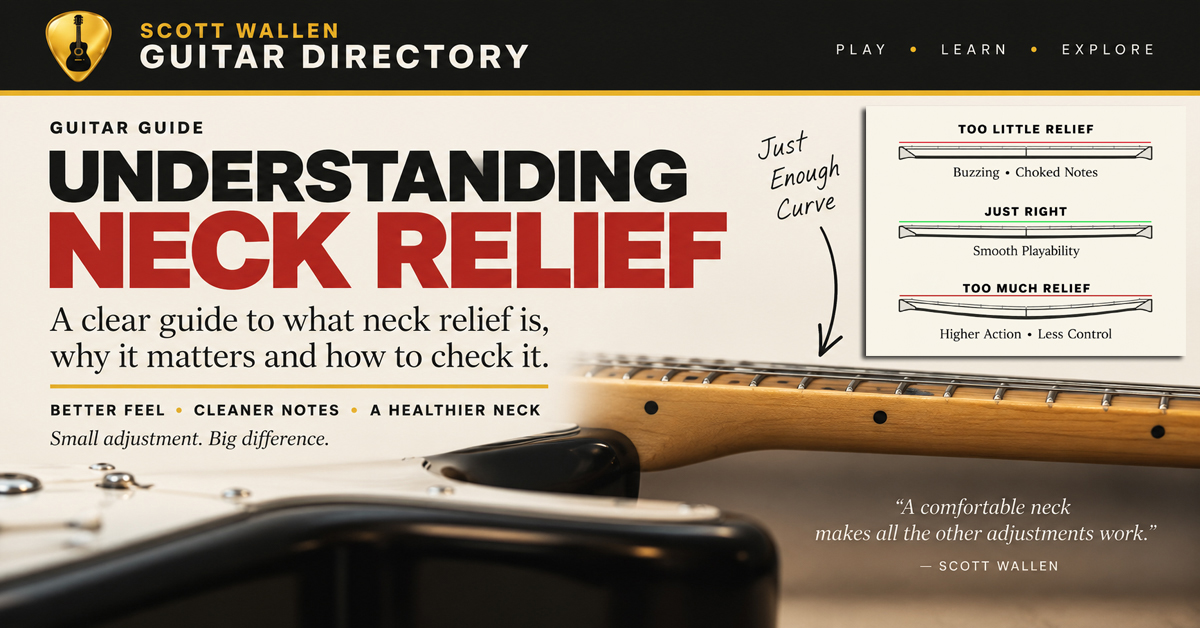
That does not mean more relief is always better. Too much curvature can make the guitar feel unnecessarily high and stiff through the middle of the neck. Too little relief—or back bow—can leave too little clearance and contribute to buzzing.
The goal is controlled curvature. Relief is not a visible bow we are trying to create. It is usually a very small measured gap.
THREE BASIC CONDITIONS
Too little, a little, and too much
There is no single perfect number for every guitar and player. Manufacturer guidance, fret condition, string gauge, tuning and playing style all matter.
HOW RELIEF IS CHECKED
The string can become the straightedge
A common relief check uses the string itself as a reference line. By holding the same string down near both ends of the neck, the remaining gap over the middle frets reveals the neck's curvature.
- Tune the guitar to normal playing pitch. Relief should be evaluated with the neck under its normal string tension.
- Capo or fret the string at the first fret. This establishes one end of the reference line.
- Hold the same string down near the body end of the neck. Depending on the instrument or manufacturer's method, this may be the last fret or the fret near the neck/body joint.
- Check the gap near the middle of that span. The seventh, eighth or nearby fret is commonly used, depending on the procedure being followed.
- Use a feeler gauge when an actual measurement is needed. The gap is small enough that guessing by eye can be misleading.
Why instructions seem inconsistent: Different manufacturers and technicians may specify a different fret, string or target measurement. The underlying measurement is still the same idea: compare the curved neck to a straight reference under string tension.
RELIEF VS. ACTION
Related measurements are not interchangeable measurements
Action is the height of a string above the frets. Relief is the curvature of the neck beneath the strings. Because changing neck curvature changes the geometry of the neck, relief can change measured or perceived string height—especially through the middle frets.
That relationship causes much of the confusion. A truss-rod adjustment can make the strings feel lower or higher, but that does not turn the truss rod into the guitar's primary action-height adjustment.
R before final A. Establish neck relief first. Then evaluate and set final action using the adjustment points designed for string height on that instrument.
THE TRUSS ROD
Its job is to influence neck curvature
The truss rod counteracts forces acting on the neck and allows relief to be adjusted. On many conventional systems, tightening the rod reduces forward relief; loosening it allows string tension to pull more forward relief into the neck.
Not every truss-rod system is identical. Some instruments use double-action or other designs capable of applying corrective force in both directions. Access may be at the headstock, heel or inside the soundhole depending on the guitar.
Stop when something does not feel normal. Excessive resistance, a truss rod that seems ineffective, or uncertainty about the instrument's design are good reasons to let an experienced technician take over.
SETUP ORDER
Why relief normally comes before final action
Setup steps interact. If the neck curvature changes after the action has already been finalized, the string-height measurements may change with it. That is why relief is normally established before final action and final intonation.
This is a working sequence, not a law of nature. A technician may move back and forth between measurements while diagnosing a particular instrument. The important educational point is that final action should not be judged while relief is still changing.
ACOUSTIC VS. ELECTRIC
Same neck principle. Different instrument around it.
Relief serves the same basic purpose on acoustic and electric guitars: controlling neck curvature under string tension. But string gauges, tunings, construction, setup targets and truss-rod access can differ.
The correct target is therefore not “electric relief” versus “acoustic relief” as two universal numbers. Use the manufacturer's specification as a starting point and evaluate the individual guitar, its fretwork and the player.
WHY RELIEF CHANGES
Wood, strings and environment all participate
- String gauge changes. Different tension can change the force pulling on the neck.
- Alternate tunings. Changing overall string tension can alter neck curvature.
- Seasonal humidity and temperature. Wooden instruments can move as environmental conditions change.
- A newly settled instrument. A guitar may need another look after strings, hardware or setup conditions have changed.
A setup is a condition, not a permanent event. A guitar that played perfectly months ago can need a small correction after its environment or string tension changes.
WHAT A PLAYER OR BUYER CAN CHECK
Observe before reaching for a wrench
You can learn a surprising amount about neck relief without adjusting anything. The goal during an inspection is to recognize clues, not to perform a setup on somebody else's guitar.
- Sight along the neck. Look for an obvious forward bow, back bow or irregular twist.
- Play across different areas of the neck. Notice where buzzing or unusually high feel appears.
- Use the string-as-straightedge check. If appropriate, the basic relief check can reveal whether there is at least a small controlled gap through the middle.
- Ask about string gauge and tuning. A setup only makes sense in the context of the tension the guitar uses.
- Do not diagnose everything as truss rod. High action, buzz or poor playability can also involve frets, the nut, saddle, bridge or other geometry.
Inspection is not adjustment. Recognizing relief is useful even if you never turn a truss rod yourself.
RELATED RAINS GUIDES
Relief is one part of the setup system
DIRECTORY POSITION
Relief gives the neck its working shape
Relief becomes much easier to understand once it is separated from action. One describes neck curvature. The other describes string height. They interact, but they are not interchangeable.
That distinction is useful whether you are setting up a guitar, buying one or simply trying to understand what a technician means when they say the neck has “too much relief.”
Remember it this way: R is not A. R can affect A. Set R before final A.
SUPPORTING PERSPECTIVES
See neck relief measured and adjusted
Neck relief is easier to understand when the small amount of curvature can actually be measured. Fender and StewMac approach the subject from slightly different perspectives: one as a manufacturer explaining a standard setup procedure, the other from the repair bench with a closer look at how truss rods and neck curvature work together.
Fender · How To | Truss Rod Adjustment Fender demonstrates how neck relief is checked under string tension and how truss-rod adjustment changes forward bow or back bow. It provides a useful visual distinction between neck curvature and final string height.
StewMac · Understanding Guitar Truss Rod Adjustment Dan Erlewine takes a repair-bench approach to neck straightness, relief and several truss-rod designs, showing why the rod is a neck-curvature adjustment rather than simply an action control.
Watch for the sequence: The neck is placed under normal string tension, relief is evaluated, and only then does the rest of the setup make sense. That is the practical reason behind the RAINS distinction: R is not A. R can affect A. Set R before final A.
Fender, StewMac and Sweetwater are credited as the sources of the supporting material above. Their inclusion is for educational commentary and reference and does not imply sponsorship, affiliation or endorsement of GuitarSearch.org.